




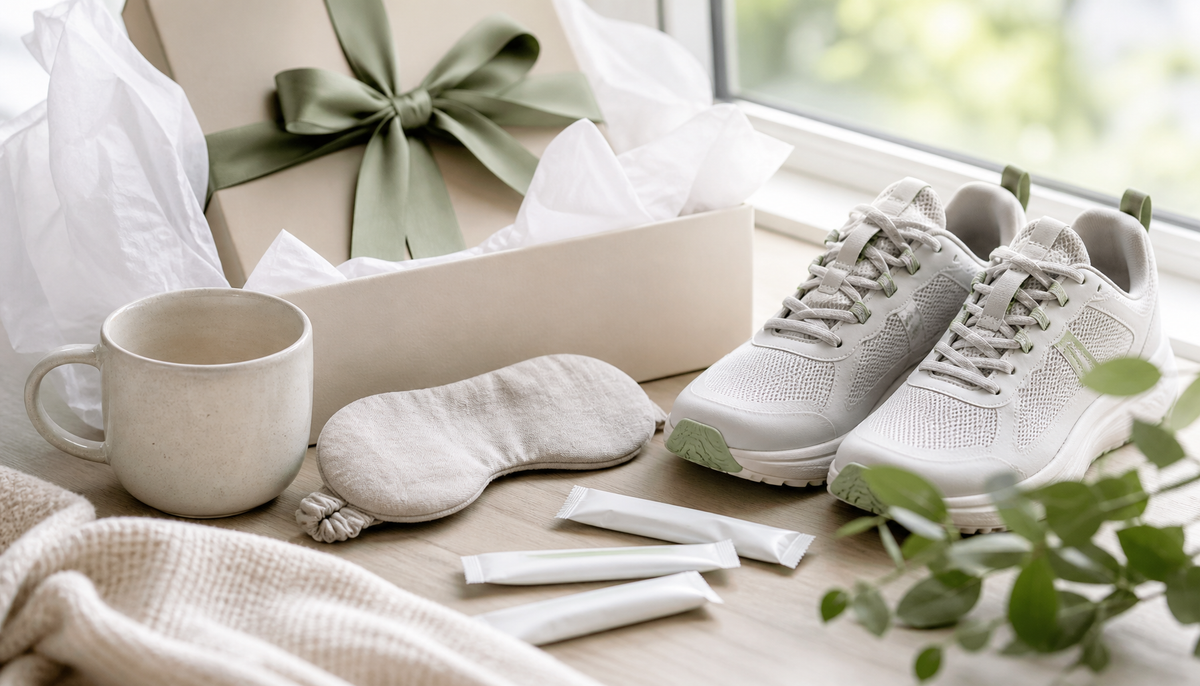
Most wellness gifts end up in a drawer. The jade roller, the 14-day detox tea, the gadget that needs its own app: well meant, used twice. Better gifts tend to share one thing. They make a habit the person already wants a little easier to keep.
This guide sorts gift ideas by what the evidence actually supports, from free to premium, so you can pick something that gets used in February, not just opened in December.
Key Takeaways
- The best wellness gifts back up habits with solid evidence: daily movement, consistent sleep, and social connection.
- Walking has some of the best data. A 2022 meta-analysis linked roughly 6,000–8,000 daily steps (adults 60+) and 8,000–10,000 (under 60) with lower all-cause mortality.
- Supplement gifts only make sense if they're third-party tested, clearly labeled, and suited to the person. Ask about medications or pregnancy before gifting.
- Pre-portioned formats (stick packs, single-scoop powders) remove friction, and friction is a big reason routines fail.
- When in doubt, give an experience you share. Time with people is one of the most robust predictors of long-term health.
The Science: What Actually Moves the Needle
Three habits keep showing up in the research as high-return and low-risk.
Daily movement. A pooled analysis of 15 cohorts with nearly 47,500 adults found that more daily steps were associated with progressively lower mortality risk, levelling off at about 6,000–8,000 steps per day for adults 60 and older and 8,000–10,000 for younger adults (Paluch et al., 2022). An earlier analysis of U.S. adults found step count mattered more than step intensity (Saint-Maurice et al., 2020). Translation: a gift that gets someone walking more is better than one that promises to make their workouts "optimized."
Sleep and evening wind-down. Consistent sleep supports mood, recovery, and appetite regulation. Among supplements, ashwagandha has a reasonable evidence base here. A 2021 meta-analysis of five randomized trials (400 participants) found a small but significant improvement in overall sleep, with larger effects at doses of 600 mg/day or more and with treatment lasting 8 weeks or longer (Cheah et al., 2021).
Connection. Shared activities count. A long-standing meta-analysis of 148 studies found that stronger social relationships were associated with a meaningfully higher likelihood of survival over follow-up (Holt-Lunstad et al., 2010). It's older research, but it hasn't been overturned, and it's the cheapest gift on this list.
Practical Steps: Gift Ideas by Habit and Budget
Under $30: Small Nudges
- A good water bottle. Visible water is water you drink. Pick one that fits a car cup holder.
- A blackout sleep mask or earplugs. Cheap, low-risk, and they tackle two common sleep disruptors: light and noise.
- A paper habit tracker or journal. Checking a box is a surprisingly durable motivator. Pair it with one specific habit, like a 10-minute walk after dinner.
- A "walk date" voucher. Free, personal, and it helps with both steps and connection.
$30–$120: Habit Infrastructure
- Comfortable walking shoes. If the evidence favors steps, remove the reason not to take them.
- A sunrise alarm clock. Gradual light in the morning is a gentler wake-up and helps anchor a consistent schedule.
- A single, well-made supplement. Choose one product with a clear purpose over a cabinet of maybes. Our guide on how to read a supplement label covers what to check: third-party testing, actual doses, and proprietary-blend red flags.
$120+: The Considered Gift
- A class pack or membership for yoga, climbing, or a walking club. Group settings add accountability.
- A complete daily routine. For the person who keeps saying they "should take something" but never builds the routine, a pre-portioned system can remove the guesswork. More on that below.
- A shared experience. A weekend hike, a cooking class, a spa day with you. Connection plus movement is hard to beat.
Gifts to Skip
- Detox teas and cleanses. Your liver and kidneys already handle this, and many "detox" products are simply laxatives.
- Anything with a proprietary blend that hides doses.
- Expensive wearables for people who've never asked for one. Data without interest rarely changes behavior.
How Supplements Fit
Supplements can be a good gift when three conditions are met: the recipient is interested, the product is transparent and third-party tested, and it fits a routine they already have. If they take prescription medications, are pregnant or nursing, or have a health condition, it's worth suggesting they check with their clinician first. Ashwagandha in particular isn't recommended during pregnancy.
Format matters more than most people think. Pre-portioned stick packs and single-scoop powders remove the daily "how many of which bottle" decision, which is often where routines break down. We've written more on building a routine that sticks and why more isn't always better.
If you'd like to give a full morning-to-night routine, here are three options at different levels:
- Daily Essentials: a multivitamin powder with probiotics, electrolytes, and amino acids in one scoop. A good fit for someone starting from zero.
- Night Recovery: 300 mg organic KSM-66® ashwagandha plus 200 mg magnesium per two-capsule serving, melatonin-free. Note that 300 mg is within the range studied in the trials above, but the meta-analysis found larger sleep effects at 600 mg/day or more. Read more in our KSM-66 research review.
- Wellness System: Daily Essentials, Night Recovery, and Total Longevity (stick packs with NMN 600 mg and Urolithin A 500 mg) bundled as one morning-to-night routine.
Frequently Asked Questions
Is it rude to give someone supplements as a gift?
Not if they've shown interest in health routines. Present it as "something you mentioned wanting to try" rather than a hint, and include the label so they can check ingredients.
What's a good wellness gift for someone who has everything?
A shared experience: a guided hike, a class, or a standing weekly walk with you. It supports movement and connection, two habits with strong evidence behind them.
What should I look for in a supplement gift?
Third-party testing, fully disclosed doses (no proprietary blends), and a clear purpose. Simple formats like stick packs make it more likely to get used.
Are wellness gadgets worth it?
Sometimes. Simple tools that lower friction (a water bottle, a sleep mask, walking shoes) usually get more use than complex devices.
When should I order holiday wellness gifts?
Aim for mid-November to avoid shipping delays, especially for bundles and subscriptions.
Ready to put the science into practice?
Evoria's Wellness System bundles Daily Essentials, Night Recovery, and Total Longevity into one morning-to-night routine. It's a gift that's easy to keep using. Shop Wellness System →
References
- Paluch AE, et al. Daily steps and all-cause mortality: a meta-analysis of 15 international cohorts. Lancet Public Health. 2022. PubMed
- Saint-Maurice PF, et al. Association of daily step count and step intensity with mortality among US adults. JAMA. 2020. PubMed
- Cheah KL, et al. Effect of ashwagandha (Withania somnifera) extract on sleep: a systematic review and meta-analysis. PLoS One. 2021. PubMed
- Holt-Lunstad J, et al. Social relationships and mortality risk: a meta-analytic review. PLoS Med. 2010. PubMed
*These statements have not been evaluated by the FDA. This product is not intended to diagnose, treat, cure, or prevent any disease.
Share:
Magnesium vs Melatonin vs L-Theanine: Which Sleep Supplement Fits Your Problem?
How to Choose a Collagen Supplement: Type, Dose, and What to Skip